1. Introduction: Why Breaking Torque Matters for Expansion Anchors
Expansion anchor bolts occupy a unique position in the fastener world. Unlike a standard hex bolt that simply clamps two components together, an expansion anchor performs three functions simultaneously: it expands a sleeve against the walls of a drilled hole to generate friction-based anchorage, it transmits load from the fixture to the base material, and it must do so without fracturing the anchor body, cracking the concrete, or seizing its internal components.
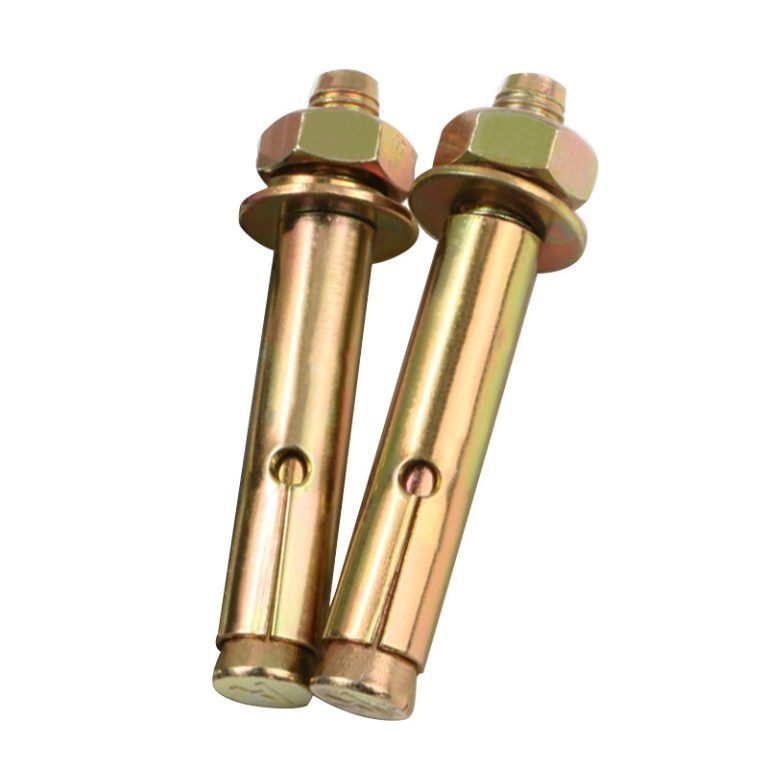
The breaking torque of an expansion anchor is the maximum torsional load the fastener can withstand before the bolt shank fractures, the threads strip, or the anchor body fails. It is a fundamental mechanical property that determines whether an anchor can be safely installed to its required installation torque without premature failure. For carbon steel expansion anchors—such as the zinc-plated sleeve anchors widely used in fencing, security doors, canopies, and air-conditioning rack installations—breaking torque is the parameter that separates a reliable anchorage from a catastrophic failure.
This article provides a comprehensive technical analysis of expansion anchor breaking torque, covering the relationship between installation torque and breaking torque, applicable testing standards, published torque data, common failure modes, and practical solutions for engineers and procurement professionals.
2. Defining the Two Critical Torques
2.1 Installation Torque (Setting Torque)
Installation torque is the torque applied to the nut during assembly to expand the anchor sleeve and generate the clamping force that holds the fixture in place. The working principle is straightforward: as the nut is tightened, the bolt is pulled outward while the metal sleeve remains stationary, causing the tapered end of the bolt to expand the sleeve and press it firmly against the walls of the drilled hole.
Installation torque serves a dual purpose: it expands the anchor to create friction-based anchorage, and it generates the clamp load that secures the fixture. For this reason, installation torque must be applied in a controlled manner using a calibrated torque wrench, within the parameters specified in the product’s technical documentation.
2.2 Breaking Torque (Failure Torque)
Breaking torque is the maximum torsional load the anchor can withstand before the bolt shank fractures, the threads strip, or the anchor body deforms to the point of failure. It is the upper limit of the anchor’s torsional capacity—the torque at which the fastener ceases to function as an anchor.
2.3 The Safety Ratio
The relationship between these two torques defines the safety margin of the anchorage:
Safety Ratio = Breaking Torque ÷ Installation Torque
Industry practice generally requires that the breaking torque exceed the maximum installation torque by a minimum factor of 1.5 to 2.0. For M10 carbon steel expansion anchors, published test data indicates an installation torque range of 25–35 N·m and a breaking torque of ≥50 N·m. This corresponds to a safety ratio of approximately 1.43 to 2.0, depending on where within the installation torque range the anchor is set.
3. Published Torque Data for Expansion Anchors
3.1 Installation Torque Values by Anchor Size
Published technical data from anchor manufacturers provides a reliable baseline for installation torque values. The following table summarizes nominal installation torque values for common expansion anchor sizes:
| Anchor Size | Nominal Installation Torque (N·m) | Maximum Installation Torque (N·m) — Some Systems | Source |
|---|---|---|---|
| M6 | 6–15 | 4 | Manufacturer data |
| M8 | 15–25 | 8 | Manufacturer data |
| M10 | 25–35 | 15 | Test standard; manufacturer data-14-45 |
| M12 | 50 | — | Manufacturer data |
| M14 | 70 | — | Manufacturer data |
| M16 | 100 | — | Manufacturer data |
3.2 Breaking Torque Data
Breaking torque data for expansion anchors is less uniformly published than installation torque, because the failure mode depends on the anchor design, the bolt material, and the thread geometry. However, the following reference points are instructive:
-
M10 carbon steel expansion anchor: Breaking torque ≥50 N·m, with installation torque of 25–35 N·m.
-
General rule for carbon steel anchors: Breaking torque should exceed the maximum specified installation torque by a factor of 1.5–2.0 to provide a safety margin against over-tightening and material variability.
3.3 The Effect of Anchor Design on Breaking Torque
The breaking torque of an expansion anchor is influenced by several design factors that differ from those of a solid bolt:
Shank cross-section: Some expansion anchors feature a reduced shank diameter or a waisted section to accommodate the expansion mechanism. This reduces the effective cross-sectional area and, consequently, the breaking torque relative to a solid bolt of the same nominal thread size.
Thread geometry: The thread on an expansion anchor must engage the nut while also transmitting the expansion force to the sleeve. Fine-pitch threads, where used, generally provide higher breaking torque than coarse-pitch threads for the same nominal diameter.
Material and heat treatment: Carbon steel anchors are typically manufactured from grades such as Q235 or equivalent, with property classes in the 4.8–8.8 range. Higher property classes provide higher breaking torque but may also reduce ductility, which is a consideration for seismic and dynamic applications.
4. Failure Modes: When Torque Exceeds Capacity
4.1 Anchor Bolt Fracture (Torsional Failure)
Mechanism: When the applied installation torque exceeds the breaking torque, the bolt shank fractures—typically at the thread runout or at a section change in the shank. This is the most direct consequence of exceeding breaking torque.
Symptoms: The nut rotates freely without building torque; the bolt head separates from the shank; fluid or debris may be visible at the fracture site.
Root Causes:
-
Over-tightening with an impact wrench or uncalibrated torque tool
-
Using an anchor with insufficient breaking torque for the specified installation torque
-
Material defect or improper heat treatment
Industry guidance explicitly warns that excessive installation torque may exceed the steel’s yield strength, causing the anchor to break, and this is especially prevalent in smaller anchors such as M6 and M8, which have smaller cross-sections and relatively low torque requirements.
4.2 Concrete Breakout Failure
Mechanism: Even if the anchor itself does not fracture, excessive installation torque can over-expand the sleeve, generating compressive stresses in the concrete that exceed its tensile capacity. The result is concrete breakout—a cone-shaped failure of the concrete surrounding the anchor.
Symptoms: A crater of concrete around the anchor; the anchor may remain intact but pull out with a section of concrete attached.
Root Causes:
-
Installation torque exceeding the manufacturer’s maximum
-
Insufficient concrete strength for the anchor size and torque level
-
Insufficient edge distance or anchor spacing
Research on M12 concrete expansion anchors has shown that installation torque level significantly affects the concrete breakout strength, and that both over-torque and under-torque conditions produce performance that differs from the manufacturer’s recommendations. Testing of torque-type anchors has revealed a high percentage of concrete failure during installation even in high-strength concrete, directly attributable to improper torquing.
4.3 Cold Welding / Seizure of Anchor Components
Mechanism: Excessive expansion pressure can cause the expansion element (sleeve or clip) to cold-weld or seize onto the bolt shank. This is particularly problematic in cracked concrete, where the expansion element must be able to expand further to accommodate crack movement.
Consequence: If seizure occurs, the anchor cannot expand further, leading to slippage and failure at a load lower than the design capacity.
5. Solutions and Best Practices
5.1 Specification and Procurement
When sourcing expansion anchor bolts for international projects, include the following in purchase orders:
-
Breaking torque requirement — Specify a minimum breaking torque that provides a 1.5–2.0× safety factor over the maximum installation torque
-
Material and property class — Carbon steel anchors should meet the specified property class (e.g., 4.8, 5.8, or 8.8) with verified mechanical properties
-
Surface finish — Zinc plating per the product specification, with passivation for corrosion resistance-1
-
Test reports — Request breaking torque test data for the specific anchor design, not generic values
5.2 Installation Control
-
Use a calibrated torque wrench for all structural and safety-critical anchor installations. The only way to ensure the required torque is applied accurately is by using a calibrated tool in accordance with the manufacturer’s conditions.
-
Never use impact wrenches for final tightening of expansion anchors—the torque spikes can instantaneously exceed the breaking torque.
-
Follow the manufacturer’s torque specification exactly. Do not substitute generic torque charts, because installation torque is design-specific.
-
Reach full torque within the specified number of turns. Industry installation specifications require that, after reaching 10% of the specified torque, 100% of the specified torque shall be reached within seven or fewer complete turns of the nut.
-
Clean the hole thoroughly before installation. Dust, oil, and debris reduce friction and bond strength, and can cause the anchor to slip at loads below its design capacity.
5.3 Quality Verification
-
Perform torque testing on a sample of installed anchors. Many construction specifications require torque wrench testing on not less than 50% of installed expansion anchors, and at least one anchor for every piece of equipment containing more than two anchors.
-
Verify breaking torque through supplier test reports and, for critical applications, through third-party laboratory testing.
-
Check anchor condition before installation—reject anchors with damaged threads, deformed sleeves, or corrosion products that could affect friction and torque transmission.