A Question Every Buyer Encounters
If you purchase self‑clinching studs (press‑fit standoffs and studs) for sheet‑metal assembly, sooner or later you will run into a specification like “3.5M3” and ask yourself the same question thousands of other buyers have asked: Is the “3.5” part of the thread size? Is “3.5M3” actually an M3.5 thread? It is one of the most common — and most dangerous — points of confusion in fastener procurement. Misreading it means ordering the wrong part, and the error is often only discovered at the assembly line, where it stops production and burns through budget.
The honest answer, based on the industry’s own published specification data, is that “3.5” is not a thread dimension at all. It is a code that denotes the “large‑size variant” of an M3 self‑clinching stud. Both M3 and 3.5M3 studs carry the identical M3 × 0.5 thread, but they are engineered to fit different sheet‑metal hole diameters and have different overall physical dimensions. Understanding this distinction is not academic — for a buyer it is the difference between a smooth, on‑time shipment and a rejected batch that must be re‑ordered at your own cost.
This guide breaks down the M3 vs 3.5M3 question (and the equivalent imperial codes 440/6440, 632/8632) from the buyer’s perspective, combining the original technical article’s data with industry best practices, real‑world failure cases, and concrete procurement‑side solutions.
1. What Exactly Is a Self‑Clinching Stud?
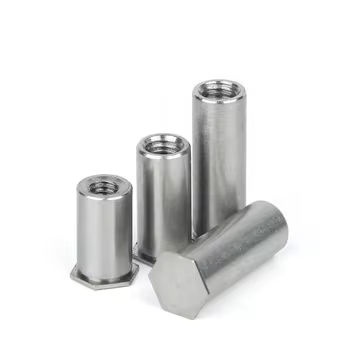
Before we can read a specification correctly, we need to know what the part actually is. A self‑clinching stud (压铆螺柱) is a precision fastener designed to be permanently press‑fitted into a thin metal sheet. It consists of a threaded shaft and a hexagon (or round) clinch base. When pressed into a pre‑punched hole with sufficient force, the sheet‑metal material flows around the clinch base and locks the stud permanently in place — no welding, no riveting, no extra hardware.
There are two broad families:
- Through‑hole type (SO series): the hex base end is open, and a fastener can pass fully through the stud.
- Blind‑hole type (BSO series): the hex base end is closed, providing a blind threaded hole.
The “M3 vs 3.5M3” logic applies to all stud types — SO, BSO, SOS, BSOS, SO4, TSO — which is precisely why this single point of confusion can quietly generate wrong orders across an entire product range.
2. The Core Question Answered: M3, 3.5M3, and M3.5 Are Three Different Things
This is the heart of the original article, and it is essential for any buyer to internalise. Let us separate the three designations clearly:
2.1 Pure “M3” — The Standard (Small) Variant
When a specification reads SO‑M3‑10 (meaning: SO series stud, M3 thread, 10 mm length), you are looking at the standard M3 self‑clinching stud:
- Thread: M3 × 0.5
- Board hole diameter required: 4.2 mm
- Hex across‑flats: 4.2 mm
- Groove (slot) diameter: 3.85 mm
- Minimum sheet thickness: 1.0 mm
2.2 “3.5M3” — The Large Variant of the Same Thread
When a specification reads SO‑3.5M3‑10, the thread is still M3 × 0.5. The “3.5” is a code, not a dimension. What has changed:
- Board hole diameter required: 5.4 mm (not 4.2 mm)
- Hex across‑flats: 6.35 mm (larger base)
- Groove (slot) diameter: 5.85 mm (larger)
- Minimum sheet thickness: 1.0 mm
So “3.5M3” simply means “the large‑size version of an M3 stud”. It is a manufacturing/product code that distinguishes two studs that share a thread but serve different hole sizes and carry different base dimensions.
2.3 “M3.5” — The Real M3.5 Thread
To avoid confusion, note that a genuine M3.5 thread (M3.5 × 0.6) does exist in the specification table. M3.5 is not the same as 3.5M3. A spec reading SO‑M3.5‑10 means the stud has an actual M3.5 thread, and it also requires a 5.4 mm board hole. In other words:
- M3 = real M3 thread, small variant, 4.2 mm hole.
- 3.5M3 = real M3 thread, large variant, 5.4 mm hole.
- M3.5 = real M3.5 thread, 5.4 mm hole.
Three designations, three different parts — and a buyer who conflates any two of them will receive the wrong inventory.
3. The Same Logic Applies to Imperial Codes
The original article extends the same principle to imperial (inch) self‑clinching studs, where the codes are 440/6440 and 632/8632:
- 440 and 6440 are both #4‑40 UNC threads. “6440” is the large variant (larger base and hole).
- 632 and 8632 are both #6‑32 UNC threads. “8632” is the large variant.
For a buyer sourcing from mixed metric/imperial drawings, this is a second silent trap: the “prefix” (the extra leading digit) signals size variant, not thread pitch or diameter.
4. Why This Confusion Is So Costly for Buyers: Common Industry Problems
From a purchasing and procurement standpoint, the M3/3.5M3 ambiguity triggers a chain of expensive failures. Here are the most common problems, with their measurable impact:
Problem 1: Wrong‑hole‑diameter mismatch discovered only at assembly
A buyer orders studs by “M3” without realising the drawing calls for a 5.4 mm board hole (the large‑variant design). The studs arrive with a 4.2‑mm‑class base, but the panel holes are punched at 5.4 mm. At the press station, the stud either spins freely in the hole (no clinch lock) or pulls out under minimal load. The entire production batch of panels must be either re‑punched or scrapped.
Measurable impact: Pull‑out resistance drops by more than 60% when a stud is pressed into an oversized hole, because the sheet metal can no longer flow into the clinch groove. Scrap and re‑work on such a batch can consume 10–18% of the project budget.
Problem 2: Ordering “M3.5” thinking it means “3.5M3”
Conversely, a buyer who interprets 3.5M3 as a thread size may order M3.5‑threaded studs when the drawing actually specifies an M3 thread. The parts will not mate with the M3‑threaded screws already in stock, forcing an emergency re‑order with 7–15 working days of delay — exactly the kind of interruption that misses production deadlines.
Problem 3: No QC gate for the prefix
Many purchasing teams inspect thread pitch and length on incoming goods but never verify the variant code against the board‑hole spec. The error is therefore not caught at goods‑in, but at the press station or, worse, in the field.
Problem 4: Mixed variants in one BOM (bill of materials)
Projects that use both M3 and 3.5M3 in the same enclosure create a subtle inventory‑control risk: because both are labelled “M3 thread,” warehouse staff may bin them together. An assembler then picks the wrong variant and presses it into the wrong hole, creating hidden joint‑quality defects.
5. Buyer‑Facing Best Practices to Eliminate This Failure Mode
As a procurement professional, you can close the gap with five disciplined actions:
Action 1: Standardise your ordering nomenclature
Make it mandatory that every purchase order uses the full type + thread‑code + length string (e.g., SO‑3.5M3‑10). Ban the use of a bare “M3” on any drawing, RFQ, or PO that targets the large variant. This single rule removes most ambiguity at the source.
Action 2: Build a variant‑check into goods‑in inspection
At incoming QC, verify three things against the PO: (a) the thread code stamped/present on the part or its packaging, (b) the hex‑across‑flats dimension (4.2 mm vs 6.35 mm), and (c) a press‑fit pull‑out test on a sample pressed into the correct board hole. If the drawing says 5.4 mm hole but the part measures 4.2 mm across flats, reject the batch before it reaches the line.
Action 3: Keep M3 and 3.5M3 in separate inventory bins
Label and segregate the two variants physically. Because both carry an “M3 thread,” operators will otherwise intermingle them. Use a distinct colour tag or separate storage location for the large variant.
Action 4: Educate the assembly team
Run a 15‑minute training session on reading the spec table. The single biggest field mistake is pressing a small‑variant stud into a large hole. Show operators the board‑hole Ø column and the hex‑size difference.
Action 5: Add an explicit “board hole Ø” line to every RFQ
When you send a request for quote, include the sheet thickness, the board hole diameter, and the thread code together. A competent supplier will flag any mismatch — but only if you give them the data. Supplying just “M3 stud, 10 mm” invites an expensive guess.
6. Conclusion: A Small Code, a Large Consequence
For anyone who buys or specifies self‑clinching studs, the M3 vs 3.5M3 distinction is not trivia — it is a genuine procurement risk with real financial and scheduling consequences. The “3.5” is a variant code, not a thread size; the true thread is M3 × 0.5, and what changes is the board‑hole diameter and the stud’s base dimensions. The same principle governs imperial codes like 440/6440 and 632/8632.
By standardising your ordering nomenclature, building variant checks into goods‑in inspection, separating inventory, training operators, and providing complete board‑hole data on every RFQ, you can eliminate this entire class of specification errors — protecting your production schedule, your budget, and your supplier relationship.
When in doubt, always ask the supplier to confirm the board‑hole diameter your stud will fit. A reliable fastener partner will not just sell you “an M3 stud” — they will ask you for the hole size, the sheet thickness, and the required pull‑out strength, precisely so that the part they ship is the part your line can actually press.